Adversarial Pattern Evades Automated Camera Detection
A Def Con demonstration showed a computer-generated vehicle pattern evading one automated camera's detection, but it did not make the car invisible or stop video recording.
The short version
What you need to know
- Security researcher Bill Swearingen says his noRecognition model generated patterns that defeated 11 open-source detection algorithms in lab testing.
- TechCrunch reported a Def Con demonstration in which a pattern-covered car avoided detection by a Flock camera, although the wheels remained a challenge and the wider real-world evidence is still early.
- The pattern targets automated object detection; it does not stop a camera recording footage, make a person physically invisible or replace legal and policy controls on surveillance.
What happened?
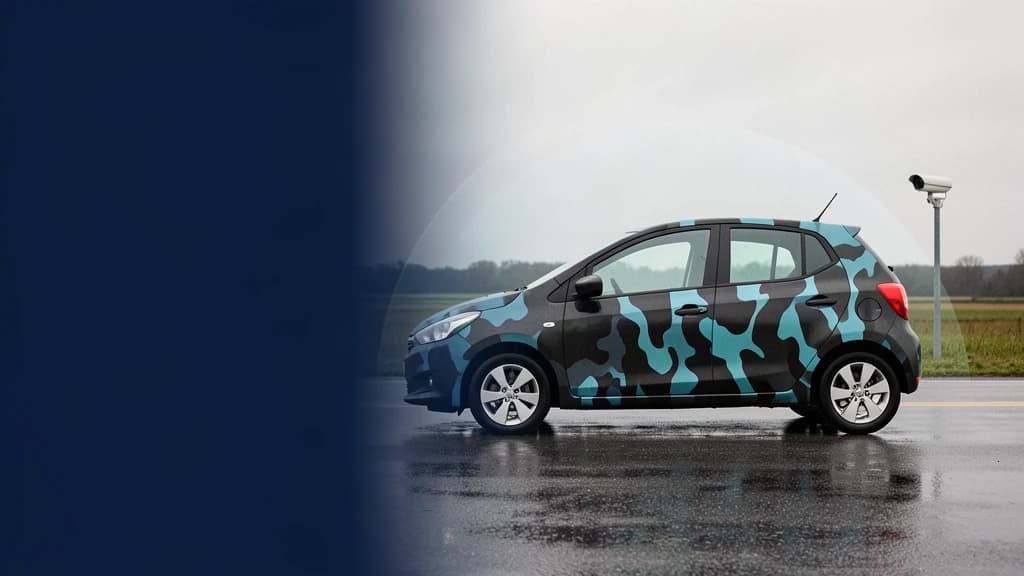
TechCrunch reported on 9 August that security researcher Bill Swearingen demonstrated a computer-generated pattern designed to confuse automated surveillance-camera detection. At Def Con in Las Vegas, the pattern was applied to a 2009 Toyota Yaris for a test against a Flock camera; Swearingen told the publication that the car avoided detection, while noting that the wheels were difficult to cover effectively.
Swearingen says his noRecognition project used reinforcement learning and roughly 31 million tests to develop patterns against 11 open-source detection algorithms. The claim is promising but should be read as early research and a single public demonstration, not proof that one printed design reliably defeats every camera, angle, distance, lighting condition or future software update.
What the pattern does—and does not do
Modern camera systems can use software to identify a person, face, vehicle or number plate and then trigger an alert or make recorded footage searchable. An adversarial pattern is intended to disrupt that software classification so the covered subject is less likely to be automatically flagged.
The camera can still record ordinary video. A human reviewer may still see the subject, another camera may use a different model, and uncovered features can remain detectable. TechCrunch reported that Swearingen is keeping his strongest patterns offline so camera vendors cannot immediately train against them, which also means the strongest designs have not received broad independent testing.
Why it matters
Automated detection changes surveillance from passive recording into large-scale, searchable tracking. That can affect people attending protests, travelling through a city or simply moving between places where camera networks share data. Research that exposes brittle detection systems can help regulators and buyers question error rates, oversight and the consequences of false matches.
Evasion technology also creates a security trade-off: the same weakness that offers a privacy opt-out could be used to avoid legitimate safety controls. The durable response is therefore not an arms race of patterns alone. Operators should minimise collection, set retention limits, test bias and failure modes, require human review for consequential decisions and provide meaningful accountability.
What you can do now
Do not treat commercial adversarial clothing or vehicle wraps as guaranteed invisibility products. Look for independent tests against the actual camera systems and conditions involved, and remember that conspicuous patterns may attract human attention even when an algorithm misses them.
For everyday privacy, reduce unnecessary face and number-plate exposure online, review location sharing, strip location metadata before public uploads when appropriate and ask organisations how their camera analytics are used. People facing targeted surveillance should seek threat-model advice from a trusted digital-rights or security organisation rather than relying on a single garment or accessory.
Where a VPN helps — and where it does not
A VPN can hide your normal public IP address from many websites and protect internet traffic between your device and the VPN server. That is useful against some forms of online network observation, especially on untrusted Wi-Fi.
A VPN has no control over a physical camera pointed at you, its local detection model or footage stored by the camera operator. It cannot hide your face, clothing, vehicle or number plate. Camera surveillance and network surveillance are different layers, so each needs its own safeguards.
VPN Rocks view
The Def Con test is a useful demonstration of how confident-looking AI detection can fail. It is not yet a consumer-ready promise of anonymity, and the distinction between avoiding an automated alert and avoiding recording altogether is essential.
The bigger lesson is that organisations should not treat camera analytics as infallible evidence. Transparent testing, narrow use, short retention and human accountability matter more than marketing claims about what a model can recognise.
Primary reading
Sources and further reading
We add plain-English context and practical advice. These links let you inspect the underlying reporting, research and official guidance directly.